San Francisco and Its Malignment

What can I say about San Francisco and the news last night about Bob Lee? It's a horrible tragedy. I didn't know him, but I could have. I have lived in the Bay Area for nearly two decades, about half of that in San Francisco. And a good chunk of that time within a 10-minute walk from where he was attacked. It's horrendous, and inexcusable, and we need to do something urgently to improve the city's crime rate and the related problem of homelessness.
That said, I am also frustrated that every time San Francisco comes up a whole host of people glom on to explain that San Francisco is the worst city in existence, and that anyone who lives or visits there is taking their life in their hands.
My experience of San Francisco was (is) of a sort of a magical place. I would often go for a run while I lived there, and what I loved most about that was the city's capacity to surprise you. You would take a turn and suddenly see some view, or some detail of the city in just the right light for the first time and have your breath taken away. It’s a beautiful, colorful place full of amazing, interesting people, a vibrant food scene, art, culture, sports, everything you could ever want in a city. And as a bonus a wonderful temperate climate, and some of the world’s best natural beauty available a couple of hours drive from the city in any direction you choose.
The economic engine of San Francisco also remains strong. Every few years I hear about how some other city or place will take the mantle for being the top place for technology in the world, and every time it’s wrong. There is just something unique here - the right mix of people, with the right skills to deliver the next world-rending technology. The most recent example - Open AI - located in San Francisco. Just when everyone was sure tech was dead.
But the city does have a crime problem, and Bob Lee’s death is just the most recent example of the havoc that can wreak. It’s tarnishing our city and needs to be resolved. At the same time, the problem is not in proportion to the social media screaming about it. Take for example Forbes 2023 list of the country’s 15 most dangerous cities, where is San Francisco on that list? It is not.
You might ask the social media commenters decrying the failure of the left to control crime in the city how they feel about Mobile, AL for example (#2) or Birmingham, AL (#3) or Memphis, TN (#5). If San Francisco is an example of the failure of the left, are these even grander examples of the failure of the right? The unfortunate reality is that crime exists in both red and blue cities, and in every city is driven by a combination of factors. Dealing with crime is hard, and every major city struggles with the issue. But we need to stop singling out San Francisco, which frankly doesn’t even rank when compared to a cross-section of major US cities.
The other thing to note is that San Francisco, like most cities, has a localized crime problem. Here is a recent crime map of San Francisco, notice a pattern?
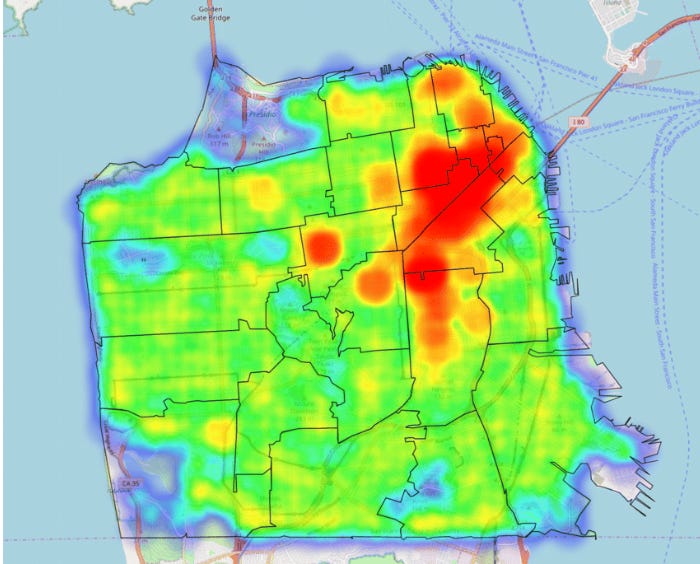
Crime in the city is localized to its Northeastern part. That diagonal line running through the map is Market Street - the city’s main downtown street, and crime emanates from it. This is also where Bob Lee was attacked, in the SOMA neighborhood (SOMA for South Of MArket). The reasons for crime’s location there are historical, city planning, and covid driven.
About in the middle of Market Street is an area called the Tenderloin. The neighborhood has historically been San Francisco’s highest crime zone, and the city has struggled to deal with it for years. In part this is a case of - poverty and crime in every city have to go somewhere, and in San Francisco this is where, but here the city also further supported the spread of crime via poor city planning.
Downtown San Francisco was built to be a place of work. If you go there you will see skyscraper after skyscraper offering office space for companies of all kinds, mixed with a variety of hotels and restaurants catering to businesspeople, and only a relatively few residential buildings. The problem with this plan is and has always been that this part of the city empties out at night and during the weekends, and that scarcity of people makes crime all the more feasible among the shadows of its large buildings.
COVID has further exacerbated this problem as the number of people present in the city’s core has dropped further, even during work hours, and more and more the criminal element has set in. Nobody could have planned for COVID, or its effects on remote work, of course, but the city certainly wasn’t set up to be resilient to this kind of downturn in its downtown area either.
It is not an excuse for the crime present in the city, but it is important to note that when that mud raking journalist sets up their camera to show what San Francisco is ‘really’ like, they certainly aren’t setting it up in Pacific Heights, or the Marina, or the Presidio, or Noe Valley, or Ocean Beach, where they might catch footage of farmer’s markets and foodie restaurants and yuppies in yoga pants, they set it up where the crime is admittedly worst. And while we shouldn’t ignore the problem areas, it’s not fair to claim that is the whole story of the city.
So, what can be done, and what are the barriers?
While no city can eradicate crime entirely, San Francisco has too often taken a soft stance on homelessness and crime. In part this has come from a place of wanting to treat those living under unfortunate conditions with humanity and respect. That is a good thing, but for a very long time we have pretended that there are real solutions to the problems we have that don’t require real intervention. We demand solutions on the one hand, but then decry police intervention, or requiring people to enter drug programs, or efforts to clear the streets on the other. This has allowed problems to fester in plain sight. The half-hearted approach to the problems downtown is also why the city can spend billions of dollars on homelessness and crime prevention services (the latest proposal is $1.5B over the next three years to provide better shelter), and still end up with a growing problem.
Hopefully Bob Lee’s death is finally a spark that gets people to wake up to the fact that this can no longer be the approach. The hard to swallow pill is that the city can put its residents first, or its homeless encampments first, but not both. It needs to decide, and neither decision will be popular.